
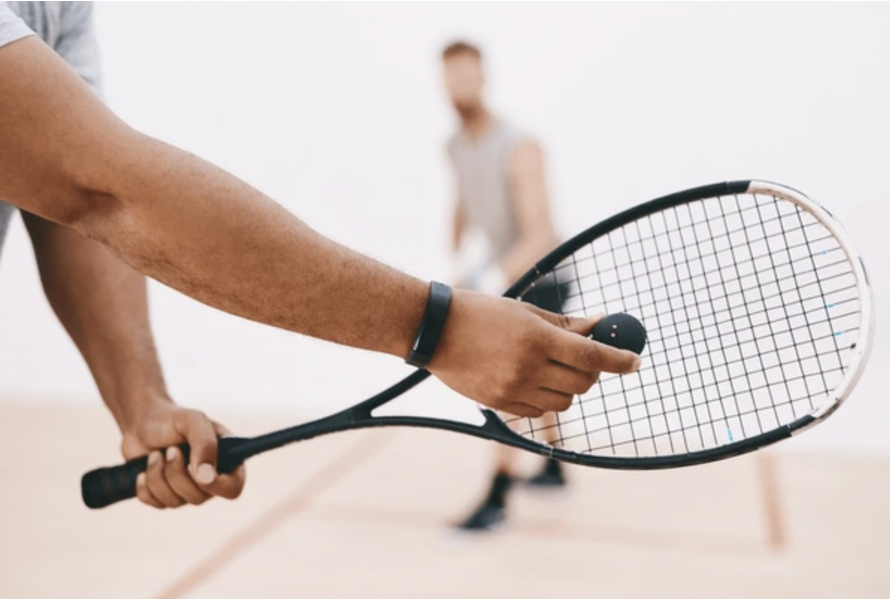
Long before analytics, squash had a simple truth.
Hit the ball deep.
Get a weaker reply.
Take it early, and finish into the front.
At its most basic level, this is how squash is won — across eras, styles, and levels. Everything else is an addition.
When we began breaking down match data, it wasn’t surprising that two of the first metrics we formulated captured this exact idea: % Backcourt and % Volleys. Not because they are fashionable, but because they reflect fundamentals that have always mattered.
 |
Depth as the foundation
% Backcourt measures the proportion of shots that bounce into the backcourt, past the short line.
Across age groups and standards, one pattern shows up consistently: a % Backcourt of around 70% signals reliable depth and forms a strong foundation for controlling rallies. At the professional level, this is almost universal. At junior levels, it varies far more — often because players go hunting for short kills or quick points.
Depth still matters for simple reasons. It pushes opponents away from the T. It limits their attacking options. It buys time to recover and reset.
Players who struggle to hit deep consistently tend to find themselves under pressure more often, defending from poor positions, and chasing rallies instead of controlling them. Depth doesn’t win points directly — but without it, sustained control becomes very hard.
The 70% figure isn’t a guarantee of success. It’s a baseline. Below it, depth becomes a weakness the opponent can exploit. At or above it, depth stops being the issue — and other skills are allowed to decide the rally.
Taking it early: intent over comfort
% Volleys measures the proportion of shots taken before the bounce.
Whether it’s BU11 or GU17, five-shot rallies or fourteen-shot marathons, one signal appears again and again: a volley rate of around 25% reflects an intent to take time away — an intent that strongly correlates with players who apply pressure and win more often.
The key is developing this habit early, so intent becomes instinct.
Players who volley less frequently tend to allow opponents to recover, drift into comfortable neutral exchanges, and miss chances to sustain pressure. Very often, this isn’t about technical ability. It’s about intent.
There’s a certain comfort in moving back and hitting a “perfect” length. Taking the ball early requires commitment — and a willingness to be uncomfortable.
But when players do take it early, a cascade of effects follows. The opponent’s reaction time drops. Their movement stretches. Their heart rate rises. Control of the rally shifts.
Over time, this opens the door to nuance: half-volleys, volleying into both the front and back, taking time away without unnecessary risk.
Why depth and volleys can’t be separated
Looked at together, the data keeps reinforcing the same picture.
Depth without volleys allows pressure to fade.
Volleys without depth increase risk.
Depth combined with volleys creates control.
The ability to volley consistently is closely linked to footwork readiness, T-position discipline, and balance after each shot. If a player is late, off-balance, or drifting away from the T, the volley option disappears — no matter how good their hands are.
This is why we don’t look at metrics in isolation.
Depth, volleys, movement, and positioning reinforce each other. The fundamentals of squash haven’t changed. We’re just measuring them more clearly.